The "Context" Layer
Why Architects use our drone data for preliminary planning.
1. Rapid Context
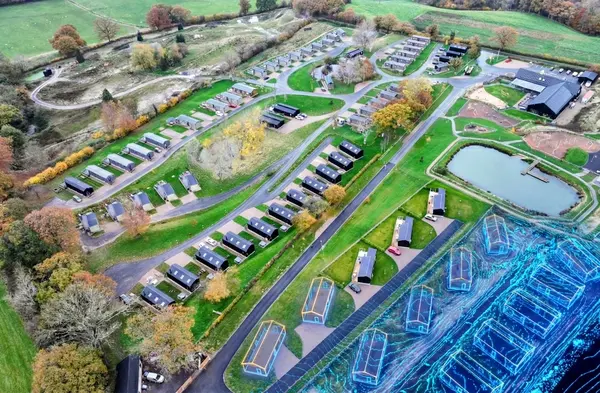
Stop designing in a void. We capture the entire site context—vegetation, slopes, and neighbouring structures—in a single flight. Import the .LAZ Point Cloud directly into Revit to see your design in situ.
2. Volumetric Estimations
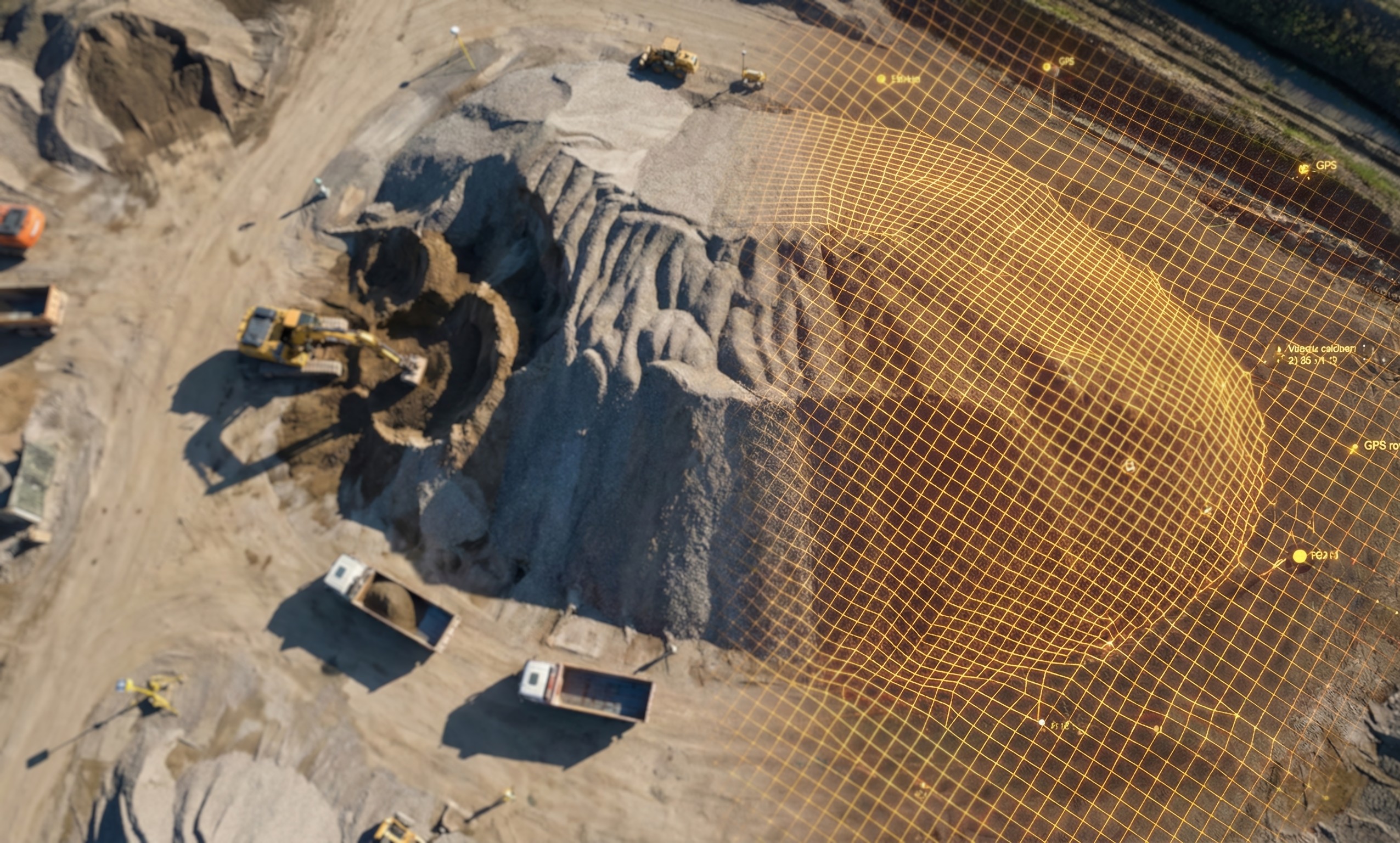
Need to calculate cut-and-fill? Our high-resolution photogrammetry models provide excellent relative accuracy for stockpile volume estimation and earthworks planning.
3. Visual Records
A timestamped "Digital Twin" of the site condition before contractors arrive. Invaluable for dispute resolution and proving site boundaries were respected.
Our Acquisition Hardware
Mavic 3 Pro (Hasselblad Edition)
We utilize flagship 4/3 CMOS optics to capture 20MP raw imagery with exceptional dynamic range. This allows us to reconstruct site geometry with high visual fidelity.
Deliverable Formats
A Note on Accuracy
Current Standard: We utilize high-density photogrammetry. While excellent for relative measurements (volumes, distances within the site) and visual context, absolute global positioning (GPS coordinates) relies on standard satellite GNSS unless Ground Control Points (GCPs) are deployed.
Coming Late 2026: We are upgrading to RTK (Real-Time Kinematic) systems for millimetre-grade georeferencing.
From Flight to File
Seamless integration into your CAD/BIM workflow.
1. Planning
We map the flight grid based on your GSD (Ground Sampling Distance) requirements.
2. Capture
The Mavic 3 Pro executes an automated grid flight, capturing nadir and oblique imagery.
3. Processing
We generate the dense point cloud and filter out noise (cars, equipment) where possible.
4. Delivery
You receive a secure cloud link to download your assets directly into AutoCAD/Revit.
Sample Outputs
Data Assurance Statement
Clarification of Scope: CalonTerra provides "Visual & Digital Terrain Data." We are not Chartered Land Surveyors.
Our data is intended for Planning, Feasibility, and Visualisation. For legal boundary disputes or final construction setting-out, we recommend verifying specific critical points with a total station.
Who Commissions Aerial Topographic Data
Four working patterns that account for most of what we fly across South Wales.
Architects and Planning Consultants
Most planning submissions need an accurate picture of what is already on the site, and a measured survey booked through a traditional practice can take weeks to schedule. A photogrammetric flight captures the existing ground, the built footprint and the surrounding context in a morning, which is usually enough to begin massing studies and to produce the existing-site drawings a validation checklist asks for. Oblique imagery from the same flight supplies the streetscape views a design and access statement needs, from angles no ground-level camera can reach.
Groundworks and Earthworks Contractors
Volume is the argument on every earthworks job. A monthly flight over a working site produces a dated surface model, so cut and fill can be reconciled against what was actually moved rather than against what was estimated at tender. Stockpiles are measured the same way, in minutes, with nobody walking a face carrying a GPS rover. Because each survey records the whole site rather than a set of spot heights, you can also go back and measure something you never thought to record at the time.
Land Agents and Developers
Site appraisal in the valleys turns on gradient and drainage far more than on plot area. A terrain model shows where water actually runs, where the usable platform sits, and how much level change a scheme has to absorb before anyone commissions detailed design. For land being brought to market, the same data set produces plan views and context imagery that make a listing legible to buyers who cannot comfortably read a contour drawing.
Estates, Farms and Heritage Sites
Large sites with many structures are expensive to record on foot and therefore rarely get recorded at all. One flight produces an orthomosaic of the whole holding plus a condition record of every roof on it, which supports drainage planning, grant applications, insurance schedules and phased maintenance budgets. Repeat the flight annually and it becomes a change record — which is the part that turns genuinely valuable after two or three years.
What "Accuracy" Actually Means Here
Two numbers get confused constantly. Ground Sampling Distance is how much ground a single pixel covers, and it governs how small a feature you can identify: fly lower and you resolve more detail. Absolute accuracy is how closely a point in the model matches its true position on the ground, and it depends on georeferencing rather than on image resolution.
A survey flown on onboard satellite positioning alone gives excellent relative geometry — distances and volumes within the model hold up well — while its absolute position can sit some way off. Where a project needs the model tied properly to Ordnance Survey coordinates, that is achieved with surveyed ground control points laid out before the flight. We will tell you which of the two your job genuinely needs, because paying for control you will never use is a common and entirely avoidable cost.
Get Topographical Rates
Upload your site boundary or describe the area.
Topographical Surveys: Common Questions
What architects, contractors and land agents ask before commissioning a flight.
How is a drone topographical survey different from a traditional land survey?
A total station or GPS rover records a set of discrete points chosen by the surveyor. Photogrammetry records the entire visible surface as millions of points, so nothing is left out because nobody thought to shoot it. The trade-off is that we capture what can be seen from above: ground obscured by dense canopy, and anything under a structure, still needs conventional survey.
What deliverables do I actually receive?
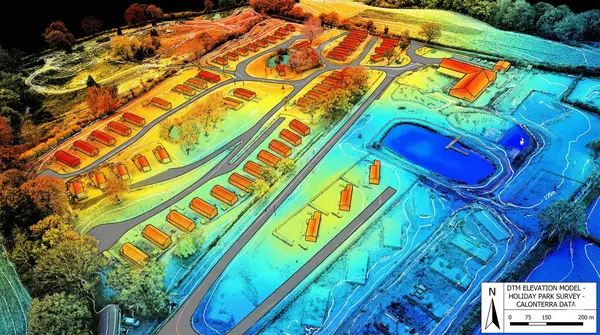
Typically an orthomosaic, a digital surface model and a filtered digital terrain model, a dense point cloud, and the source imagery. Formats are agreed before the flight so the data drops straight into your workflow rather than needing conversion at your end.
How large an area can you cover in one visit?
A single site of a few hectares is comfortably a morning's work including setup. Larger sites are flown as multiple sorties in the same visit and merged in processing. The limiting factors are usually flight endurance, the ground control requirement and the weather rather than area alone.
Do you need ground control points on my site?
Only if the model has to be accurately positioned in real-world coordinates. Volumes, gradients and dimensions within the model are reliable without control. Tying the survey to Ordnance Survey datum for setting out or for combining with existing survey data does require it, and we will say so at quotation stage rather than afterwards.
Can you fly a live construction site while work continues?
Yes, and progress recording is one of the most common reasons to book. We work to the site's own permit and induction requirements, coordinate with the site manager over plant movements and personnel, and can schedule flights at shift changes to reduce the number of people beneath the aircraft.
What weather stops a survey flight?
Persistent rain, low cloud below the planned flight altitude, and wind beyond the airframe's limit. Overcast but dry conditions are actually ideal for photogrammetry, because flat lighting removes the hard shadows that degrade a point cloud. If we attend and cannot fly usefully, there is no charge and the visit is rescheduled at the original quoted rate.
Are you a chartered land surveying practice?
No, and we are explicit about it. CalonTerra supplies visual and digital terrain data for planning, feasibility, volume estimation and visualisation. For legal boundary determination or final construction setting-out, that data should be verified against conventional survey by a chartered practice.